Someone in your area has a leaking tap, a sore foot or a dead hedge. They pull out their phone, type what they need, and look at the map. Three businesses come up. They call one of them.
Local SEO is how you become one of those three.
The good news: it’s not rocket science, and a lot of it costs nothing but time. The bad news: most of the advice out there is either too vague (“optimise your profile!”) or written for marketers. This guide is neither. It’s what we actually do for small businesses across Australia, step by step, in plain English.
Local SEO in 30 seconds
- What it is: getting your business to show up when people nearby search for what you do, on Google Maps, in the top three map results and in normal search.
- How Google picks: three things, in its own words: relevance (do you match the search?), distance (how close are you?) and prominence (how well known and well reviewed are you?).
- What matters most: a complete Google Business Profile with the right category, steady genuine reviews, the same details everywhere, and a website that clearly explains what you do and where.
- How long it takes: profile fixes can show up in weeks; reviews, links and content build over months.
- Cost: the basics are free. Help from a professional is usually a monthly fee.
What is local SEO?
Local SEO (local search engine optimisation) is the work that helps your business show up when people search for something near them. Think “electrician near me”, “podiatrist Norwood” or “coffee van for weddings Brisbane”.
Those searches show results in three places:
- The map pack. The map with three businesses under it, near the top of Google. This is prime real estate.
- Google Maps itself. Where people go when they’re already in the car or comparing options.
- The normal search results, below the map, where your website ranks.
Local SEO works on all three. And now there’s a fourth: AI answers like Google’s AI Overviews and ChatGPT, which lean on much of the same information. More on that later.
Local SEO vs SEO: what’s the difference?
| Normal SEO | Local SEO | |
|---|---|---|
| Goal | Rank your website for a topic | Show up for people in your area |
| Main battleground | Search results | Map pack, Google Maps and search results |
| Biggest levers | Content, links, technical health | Google Business Profile, reviews, consistent listings, local pages |
| Who needs it | Anyone with a website | Any business that serves a local area |
If your customers are mostly within driving distance of you, or you drive to them, local SEO is where to start.
How Google decides who shows up on the map
You don’t have to guess. Google’s own help page on local ranking says local results come down mainly to three things.
| Factor | What it means | Can you change it? |
|---|---|---|
| Relevance | How well your profile matches what someone searched for | Yes, a lot. This is where most quick wins live. |
| Distance | How far you are from the searcher, or from the place they typed | Not really. You can’t move your shop. |
| Prominence | How well known you are: reviews, rating, links, articles, directories and your website’s rankings | Yes, over time. |
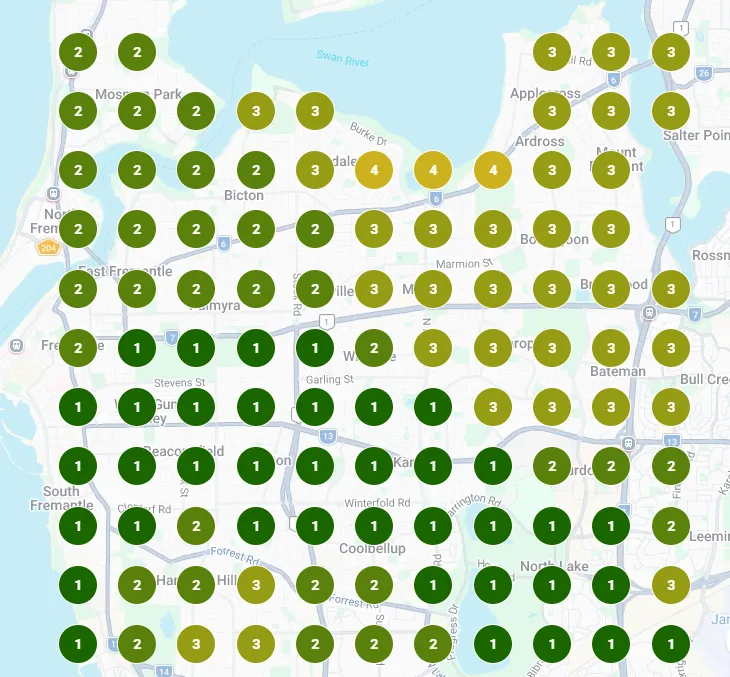
A Maps grid report shows where you rank across your service area.
Google specifically says that more reviews and positive ratings can improve your local ranking, and that normal SEO best practice applies too, because your website’s position in search results counts.
So the game is simple to describe: be the most relevant answer, and the best-known one, among the businesses near the searcher. Here’s how.
The local SEO checklist for small businesses: 8 steps
Work through these in order. The first three are the foundations; skip them and the rest won’t stick.
1. Claim, verify and fill in your Google Business Profile
Your Google Business Profile is the listing that shows on Maps and in the map pack. Claim it, verify it, then fill in every field (or optimise your profile properly with our help):
- Primary category. The single most important choice on your profile. Pick the most specific one that describes your main service (“Podiatrist”, not “Medical clinic”). Add secondary categories for other services you genuinely offer.
- Services, with a short description of each.
- Service areas (if you travel to customers) or your address (if they come to you).
- Hours, including public holiday hours.
- Description in plain English: what you do, who for and where.
- Photos of real jobs, your team, your van or your premises. Add new ones regularly.
- Posts for offers, recent jobs and news. Little and often beats a burst.
2. Use your real business name (no keyword stuffing)
It’s tempting to call yourself “Dave’s Plumbing | Emergency Plumber Adelaide | Blocked Drains”. Don’t. Google’s guidelines say your profile name should match your real-world business name. Stuffed names can get your profile suspended, and a competitor can report you.
3. Get your details identical everywhere
Your name, address (if shown), phone number and website should match exactly on your website, Google, Facebook, Apple Maps, Bing and every directory. Google cross-checks this information across the web. Mismatched details make it less sure you’re who you say you are.
Service-area business? If you go to customers and don’t have a shopfront, you can hide your address on Google and list the suburbs you cover instead. Just don’t use a virtual office or a PO box as your address.
4. List your business in the right Australian directories
These mentions are called citations, and they feed prominence. Start with the ones customers actually use:
- Apple Maps (Apple Business Connect) and Bing Places
- Yellow Pages, True Local and Hotfrog
- Trade and service sites like hipages, Oneflare and ServiceSeeking, if they fit your industry
- Your industry association and local chamber of commerce
Quality and accuracy beat quantity. Ten correct listings do more than 100 messy ones.
5. Collect reviews every week, and reply to all of them
Reviews are the prominence factor you can move fastest. What works:
- Ask at the happy moment: job done, customer smiling. Send a direct review link by text the same day.
- Make it one tap. A Google review NFC card or plaque on the counter or in the van lets customers tap their phone and land straight on your review form.
- Reply to every review, good and bad. Mention the service and suburb naturally (“Thanks Sarah, glad the switchboard upgrade in Glenelg went smoothly”).
- Steady beats sudden. Two reviews a week for a year looks far more natural than 50 in a month.

Tap-to-review plaques make asking for reviews effortless.
What not to do: don’t pay for reviews, offer discounts in exchange for them, or only ask the customers you know are happy. Google’s review policies don’t allow it, and fake or incentivised reviews can be removed.
6. Build a website that backs your profile up
Your profile gets you seen. A website that backs your profile up closes the deal and adds relevance. Make sure it has:
- One page per main service, explaining what’s included, roughly what it costs and how long it takes
- Location pages for the areas you really serve, each with genuinely local content: jobs you’ve done there, photos, local details. Not one page copied 40 times with the suburb swapped; Google calls those doorway pages and treats them as spam.
- Your name, phone and service area in the footer, matching your profile
- Tap-to-call buttons and fast loading on a phone
- LocalBusiness schema (structured data) if your site supports it. It helps Google read your details, though it’s a nice-to-have, not magic.
7. Get mentioned around town
Links and mentions from local websites tell Google you’re part of the community. Easy places to start: sponsor a junior sports club, join your local business chamber, get listed by your suppliers, offer to be quoted by local news, or co-host something with a neighbouring business.
8. Track what’s working
You can’t improve what you don’t measure. Check these monthly:
- Google Business Profile performance: calls, website clicks, direction requests and the searches people used to find you
- A Maps grid report: shows where you rank, suburb by suburb, across your area. Most owners are surprised how much it changes a few streets away.
- Google Search Console and Google Analytics: how your website is performing in search and how many visitors turn into enquiries
Want to see your grid? Get a free Google Maps report from us.
Local SEO for small businesses: real Australian results
This is what the checklist looks like in practice, for real clients who’ve agreed to be named.
| Business | Where | What we did | What changed |
|---|---|---|---|
| Ray Sawtell, chauffeur | Adelaide Hills | Google Business Profile and local SEO | Top of Google Maps, more enquiries |
| Melville Ceilings | Perth | Optimised the Google Business Profile | Traffic up 34% in four months |
| Night Grind, mobile coffee | Brisbane | Built the websites and optimised the Google profile | From no website and few enquiries to ranking at the top for its keywords in multiple areas |
| PV Podiatry | Adelaide | Updated the website and the Google Business Profile for every location | Every clinic set up properly to be found |
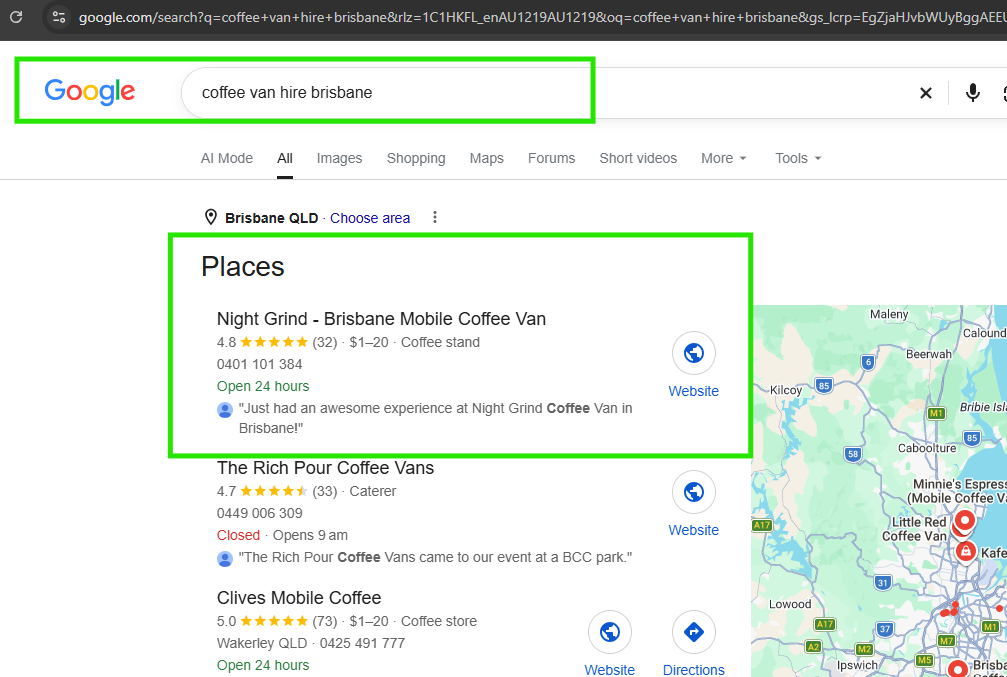
Real client result.
In their words:
★★★★★
“Eric got us to the top of Google Maps, resulting in more enquiries and added visibility to our chauffeur business.”
— Ray Sawtell, chauffeur, Adelaide Hills
★★★★★
“He helped optimise our Google Business Profile, and we’ve already noticed an increase in calls and enquiries coming through. He explained things in a way that actually made sense.”
— Louis Mahony, Melville Ceilings, Perth
★★★★★
“Eric has been great since day one when we bought a stand. Since then he’s helped build our sites and optimised our Google profile. Now we get regular leads and enquiries. Great guy to work with.”
— Darshan, Night Grind, Brisbane
Different trades, different cities, same pattern: a properly set-up profile, a website that backs it up, and steady work over time.
7 local SEO mistakes we see every week
| Mistake | Why it hurts | Fix |
|---|---|---|
| Choosing a vague primary category | Google can’t tell what you mainly do, so you miss the searches that matter | Pick the most specific category for your main service |
| Stuffing keywords into your business name | Breaks Google’s guidelines; can get you suspended | Use your real-world name only |
| Different phone numbers or addresses across the web | Google can’t confirm the details are yours | Pick one version and update every listing |
| Copy-paste suburb pages | Seen as doorway pages and spam | Fewer, genuinely local pages |
| Asking only happy customers, or rewarding reviews | Against Google’s review policies | Ask everyone, reward no one |
| Ignoring bad reviews | Looks like nobody’s home | Reply calmly, offer to fix it offline |
| Set and forget | Profiles go stale while competitors keep posting | A 30-minute weekly routine (below) |
Local SEO and AI search: what’s changed
More people now ask ChatGPT or Google’s AI answers “who’s a good [trade] near me?” before they look at a map. These tools tend to name two or three businesses, and they build their answers from much of the same information local SEO works on: your Google Business Profile, your reviews, your listings and what other sites say about you.
So good local SEO is now also your head start on AI search. If you want to go further, read our guide to AI SEO: what works and what you can ignore.
Your 30-minute weekly local SEO routine

Once the foundations are done, local SEO is mostly a habit. Put this in the diary for the same time every week.
| Time | Task |
|---|---|
| 10 minutes | Send review requests to this week’s customers, and reply to any new reviews |
| 10 minutes | Add a Google Business Profile post and two or three photos from recent jobs |
| 5 minutes | Check your profile for any edits suggested by Google or the public, and fix anything wrong |
| 5 minutes | Check calls and website clicks in your profile’s performance tab |
Once a month, add a 30-minute check of your Maps grid report and Search Console.
How long does local SEO take?
Honestly? It depends on your area and your competition. A few rough guides:
- Profile fixes (category, services, photos) can make a difference within a few weeks.
- Reviews and listings build steadily over several months.
- Competitive city searches (“plumber Sydney”) take longer than suburb or regional ones.
SEO is a slow cooker, not a microwave. Anyone promising the top of Maps in a week is either very lucky or not telling you something.
How much does local SEO cost for a small business?
The basics are free: your Google Business Profile, most directories and asking for reviews cost nothing but time. Paid tools like Local Falcon add tracking.
Hiring help is usually a monthly fee, and prices vary a lot across Australia. At WithEric’sHelp, SEO starts from $1,100 a month, with no lock-in contracts. The final figure depends on how much work your website and Google Business Profile need.
Should you do local SEO yourself or hire someone?
Do it yourself if you’re in a quieter market, you’re comfortable online and you can protect 30 minutes a week. This guide covers everything you need.
Get help if you’ve done the basics and competitors still sit above you, you cover lots of suburbs or locations, your website needs work, or you’d simply rather be on the tools than on Google. Look for local SEO help from someone who explains things plainly, shows you real results and doesn’t lock you in.