Ask ChatGPT “who’s a good plumber in Norwood?” and you won’t get ten blue links. You’ll get two or three names. Maybe a sentence about each. That’s it.
If your business isn’t one of those names, you weren’t on page two. You weren’t on the page at all.
That’s what AI SEO is about. And because it’s new, it’s attracted a lot of noise: new acronyms, new “hacks”, new tools promising to get you into ChatGPT by Friday. Some of it works. A fair bit of it Google has now told us, in writing, to ignore.
This guide sorts one from the other. It’s written for business owners, not marketers, so it’s plain English all the way down.
AI SEO in 30 seconds
- What it is: getting your business found, trusted and named by AI tools like Google AI Overviews, Google AI Mode, ChatGPT, Gemini and Perplexity.
- How it works: these tools search the web, pick a handful of sources they trust, and build an answer from them. You want to be one of those sources.
- What matters most: being genuinely useful and easy to verify. A complete Google Business Profile, steady reviews, the same details everywhere, pages that answer real customer questions, and real people talking about you.
- What you can skip: llms.txt files, “chunking” your content into tiny pages, special AI schema and fake mentions. Google says so itself.
- How to track it: Google Search Console’s Generative AI performance report, AI referrals in Google Analytics, and simply asking the tools.
What is AI SEO?
AI SEO is the work of making your business easy for AI search tools to find, understand, trust and recommend. Classic SEO aims to rank your website in the list of results. AI SEO aims to get your business named inside the answer.
The two overlap heavily. Most of what ranks you on Google also feeds what AI says about you. The difference is the finish line: a click on a link versus a mention in a sentence.
AI SEO vs GEO vs AEO: same job, different badges
You’ll see a few names floating around. Here’s the decoder ring.
| Term | Stands for | What people mean by it |
|---|---|---|
| AI SEO | AI search engine optimisation | The umbrella term most people search for |
| GEO | Generative engine optimisation | Showing up in answers written by generative AI |
| AEO | Answer engine optimisation | Being the answer, not just a link to one |
| LLMO | Large language model optimisation | Being mentioned by tools like ChatGPT and Claude |
Google’s own view is refreshingly blunt. In its guide to optimising for generative AI, it says that from Google Search’s point of view, optimising for AI search is optimising for search, so it’s still SEO. It also suggests checking any “AEO” or “GEO” service against its official guidance.
So call it whatever you like. Just be wary of anyone selling it as a brand-new discipline with secret rules.
How does AI SEO work? How AI decides who to mention
AI tools don’t make up their recommendations out of thin air (well, the good ones try not to). When a question needs current, local or specific facts, they go and look. Google explains its version of this in two parts.
- It searches first, then writes. Google calls this retrieval-augmented generation, or grounding. The AI uses Google’s normal ranking systems to fetch relevant pages, reads them, then writes an answer with links to the pages it relied on.
- It asks lots of questions at once. Google calls this query fan-out. One question becomes several related searches run side by side.
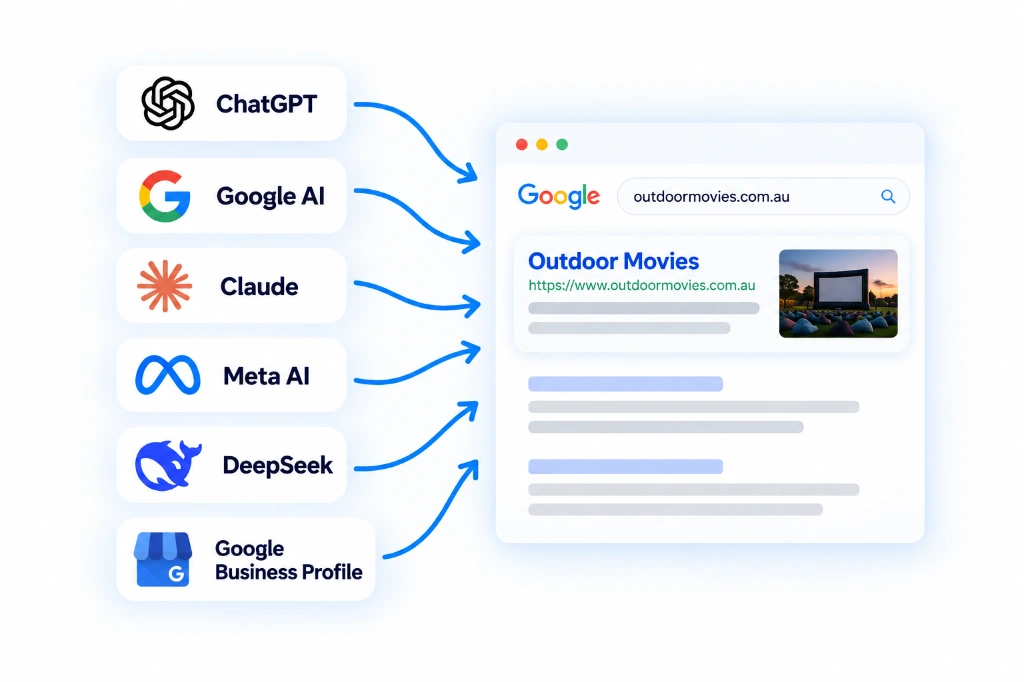
Here’s what fan-out looks like for a real customer. Someone types “best electrician for a switchboard upgrade in Glenelg”. Behind the scenes, the AI might also search:
- switchboard upgrade cost Adelaide
- licensed electricians Glenelg reviews
- signs your switchboard needs replacing
- electricians near Glenelg open Saturday
Then it pulls the businesses that keep turning up across those searches, checks what others say about them, and names a few.
The plain-English version: AI recommends businesses the way a sensible friend would. It asks around, checks the reviews, notices who keeps coming up and who looks legit, then gives you two or three names. AI SEO is making sure you’re the name that keeps coming up.
ChatGPT, Gemini and Perplexity work on a similar idea when they search the web, though each uses its own sources and its own model. That’s why the same question can get different names in different tools. It’s also why the fundamentals beat tool-specific tricks: they work everywhere.
AI SEO myths: five things Google says you can ignore
In July 2026 Google updated its official guide to generative AI search with a section on myths. If someone’s selling you any of these as the key to AI search, have a polite chat with your wallet first.

| The myth | What Google actually says |
|---|---|
| “You need an llms.txt file” | Google Search doesn’t use llms.txt or other special AI files. Having one won’t help or hurt you on Google. |
| “Chunk your content into short, scoped pages” | Not required. Google can understand several topics on one page. There’s no ideal length, so write for your reader. |
| “Rewrite everything for AI” | No special writing style needed. AI understands synonyms, so you don’t need every keyword variation. |
| “Get mentioned everywhere, by any means” | Inauthentic mentions don’t help much. The AI features rely on the same spam filters as normal search. |
| “Add special AI schema” | No special schema is needed for AI search. Structured data is still worth having for rich results. |
Google also warns against spinning up a separate page for every way someone might phrase a question. Doing it to game AI answers can breach its scaled content abuse policy.
One honest caveat: this is Google’s view of Google. Other AI tools may use things like llms.txt. But Google is where most of your customers start, and the businesses that win in AI answers are mostly winning with the basics, done well.
What actually works: the AI SEO checklist for service businesses
Most AI SEO advice is written for big brands with content teams. If you run a trade, a clinic or a local service, these seven things do the heavy lifting.
1. Treat your Google Business Profile like your shopfront
Google says AI answers can include local business details, and that a Google Business Profile helps you show up in them. Fill in every field: services, service areas, hours, photos and a proper description. Post updates. Answer the questions people ask on it.
2. Keep the reviews coming (and reply to them)
AI leans on what other people say about you. A steady trickle of genuine reviews, with replies that mention the job and the suburb, gives it plenty to work with. Ask every happy customer. Make it one tap with a short link.
3. Make your details identical everywhere
Your business name, phone number, website and service area should match across your website, Google, Facebook and every directory. When AI finds the same facts in ten places, it trusts them. When it finds three phone numbers, it gets nervous.
4. Write what only you can write
Google’s guide to creating helpful content calls this “non-commodity” content. “5 tips for a clean gutter” is commodity: anyone could write it, including the AI. “What we found in 200 Adelaide Hills gutters last winter” is yours alone. Real jobs, real prices, real photos and your honest opinion are what make AI quote you rather than skip you.
5. Give every service and area a clear page
One page per main service, written for real customer questions: what it costs, how long it takes, what’s included, which suburbs you cover. Not a page for every phrasing (see the myths above). Just a clear, useful home for each thing you sell — our own Local SEO Adelaide page is built the same way.
6. Get genuinely talked about
Local news, industry associations, suppliers, community groups, podcasts. Real mentions on real sites tell AI you’re a known quantity. Press releases and honest directory listings help here. Buying fake mentions doesn’t.
7. Get the technical basics right
To appear in Google’s AI features, a page has to be indexed and allowed to show a snippet. Check that your site isn’t blocking crawlers, loads fast on a phone and has its key information in text, not trapped in images. Google also says a site must be included in generative AI features in Search Console to be eligible, so check that setting too.
AI SEO in action: a Chatswood broker named by Google’s AI
Bang On Investments is a mortgage and finance broker in Chatswood, Sydney. They’re not a bank. They don’t have a bank’s marketing budget. But search “home loans for new doctors Chatswood” and Google’s AI Overview names them as a local specialist, and lists their page first among its sources.
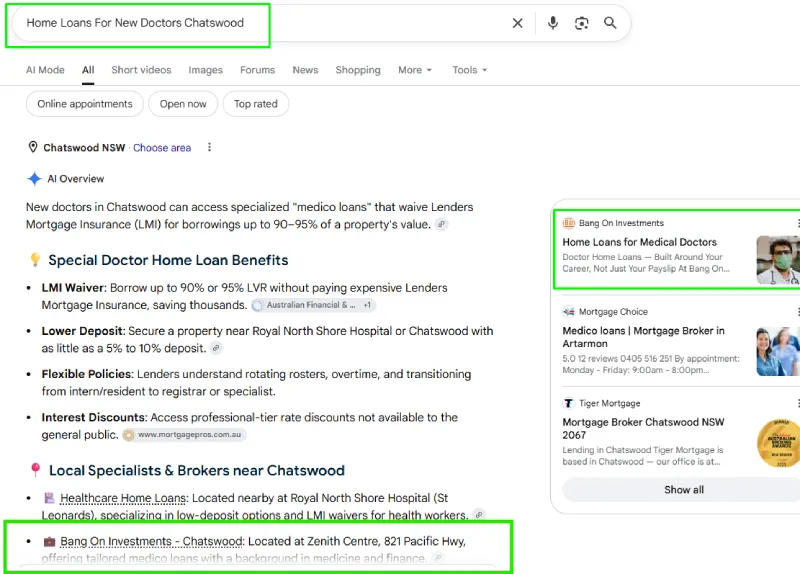
No trick got them there. Over a few weeks, we revamped their website, then built extra service pages, location pages and content around the customers they actually serve. Specific beats generic. A broker who clearly helps new doctors in Chatswood is an easy answer for AI to give. “Home loans, all of Sydney” is not.
That’s the big opportunity for smaller businesses. AI doesn’t only name the biggest brand. It names the business that best fits the question.
How to measure AI SEO (without guessing)
AI visibility is harder to track than a ranking, but it’s not a black box. Use these four together.
| What to check | Where | What it tells you |
|---|---|---|
| Generative AI performance report | Google Search Console | How your pages perform in Google’s AI features |
| Visits from AI tools | Google Analytics, Traffic acquisition, filtered to sources like chatgpt.com, perplexity.ai and gemini.google.com | Real people clicking through from AI answers |
| AI visibility tracking | Local Falcon (what we use) | How your brand shows up across AI platforms over time |
| The prompt test | ChatGPT, Gemini, Perplexity and Google AI Mode | Whether you’re named for the questions your customers ask |
Run the prompt test monthly. Write down five questions a customer would really ask, like “who’s the best [your trade] in [your suburb]?” or “how much does [your service] cost in [your city]?”. Ask each tool. Note who gets named. Same questions, same tools, every month, so the comparison means something.
One word of caution from Google: no outside tool has access to its internal ranking or AI systems. Use tracking tools for trends, not gospel.
Your 30-day AI SEO starter plan
You can do most of this yourself, about an hour a week. Tick them off as you go.

Week 1: see where you stand
- ☐ Run the prompt test above and save the answers as your starting point
- ☐ Check Search Console: is your site verified, indexed and included in generative AI features?
- ☐ Set up an AI traffic view in Google Analytics
Week 2: fix your shopfront
- ☐ Complete every field in your Google Business Profile, including services and service areas
- ☐ Add 10 recent photos of real jobs
- ☐ Make your name, phone, website and service area identical on your site, Google, Facebook and your top five directories
Week 3: get people talking
- ☐ Ask your last 20 happy customers for a review, with a direct link
- ☐ Reply to every review from the past year, mentioning the job and the suburb
- ☐ List one genuine local or industry connection that could mention you (a supplier, an association, a local paper)
Week 4: say something only you can say
- ☐ Pick your most profitable service and make sure it has its own clear page
- ☐ Add real prices or price ranges, how long it takes, which suburbs you cover and a recent job example
- ☐ Add a short FAQ with the questions customers actually ask you on the phone
Then rerun the prompt test at the end of month two and month three. AI SEO is a slow cooker, not a microwave, so look for direction rather than overnight change.
AI SEO tools for small business: what you actually need
You don’t need a $500-a-month software stack to get started. Here’s the honest list.
| Tool | Cost | Use it for |
|---|---|---|
| Google Search Console | Free | Indexing, the Generative AI performance report, spotting technical problems |
| Google Business Profile | Free | Your most important local listing for AI and Maps |
| Google Analytics | Free | Seeing visits that come from AI tools |
| ChatGPT, Gemini, Perplexity | Free tiers | Running your monthly prompt test |
| Local Falcon | Paid | Tracking Maps rankings and AI visibility over time |
| Ubersuggest | Paid, limited free use | Keyword research and finding the questions customers ask |
AI writing tools are fine for a first draft or a brainstorm. Just remember the point of AI SEO is saying something AI couldn’t say on its own. If a tool wrote it, it’s commodity by definition. Add your jobs, prices and opinions before it goes live.
DIY or AI SEO services: when to get help
Plenty of owners can handle the 30-day plan themselves. It’s worth bringing in AI SEO services when:
- You’ve done the basics and competitors still get named instead of you
- You cover lots of suburbs or services and the site needs proper structure
- You haven’t got an hour a week to spare (fair enough, you’ve got a business to run)
- You want someone to handle listings, press releases and tracking, and just show you the results
What do AI SEO services cost in Australia? Prices vary a lot between agencies. At WithEric’sHelp, SEO starts from $1,100 a month and includes the AI visibility work: listings, press releases, ongoing SEO and tracking with Local Falcon and Google Analytics. There are no lock-in contracts. The final figure depends on how much work your website and Google Business Profile need.
Be cautious of any AI SEO agency that guarantees a ChatGPT mention or a top spot in AI Overviews. Nobody controls those answers, and Google itself says no outside tool can see inside its AI systems.